St Macartan's Cathedral, Monaghan
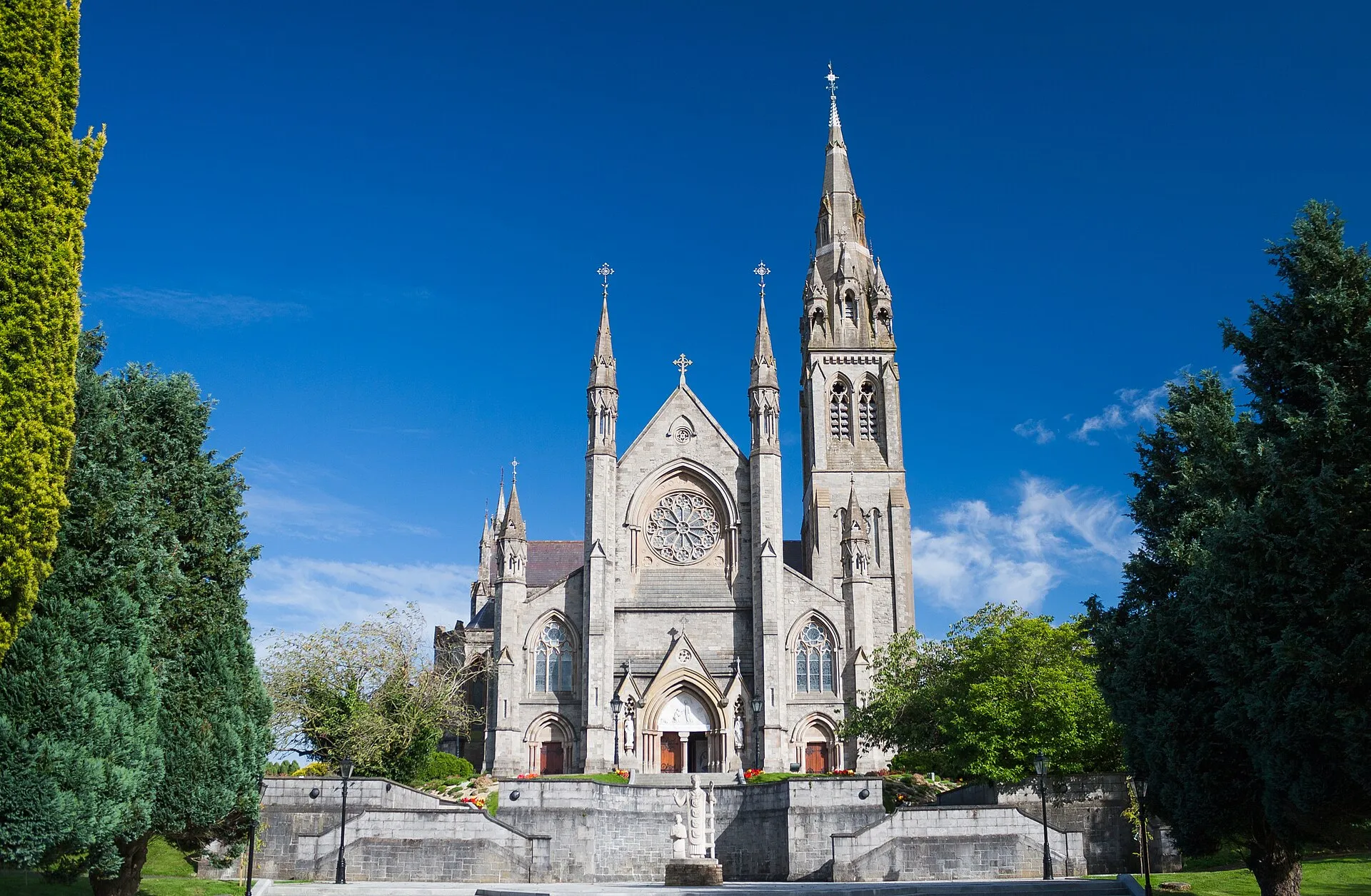
St Macartan’s Cathedral is the large stone church on the hill above the south-east side of Monaghan. Its spire is visible from most approaches to the town, which makes the building seem older than the streets below it. In fact it belongs to a very particular nineteenth-century moment, when Catholic churches were being built at a scale that would have been impossible a generation earlier.
It is the cathedral of the Roman Catholic Diocese of Clogher and an active place of worship. It is also one of the best pieces of Gothic Revival architecture in the county. Those two facts need to be held together when visiting. This is not a museum with fixed public access, but a working church that may be open outside services.
Why the cathedral is in Monaghan
The Diocese of Clogher takes its name from the village of Clogher in County Tyrone, but Bishop Charles McNally decided in 1851 to move the episcopal seat to Monaghan. The town was larger, growing and better placed for the Catholic population the diocese served.
At a public meeting in January 1858, local Catholics agreed to begin the cathedral project. McNally bought an eight-acre site on high ground and commissioned James Joseph McCarthy, the most prolific Irish Catholic church architect of the period. The foundation stone was laid in June 1861.
McNally died in 1864, long before the work was finished. His successor, Bishop James Donnelly, kept the project going through difficult economic years. McCarthy died in 1882 and the Cavan architect William Hague completed the design, including the spire and organ gallery. The cathedral was dedicated on 21 August 1892, more than thirty years after the foundation stone went down.
That long construction period explains why the building feels coherent but not quite the work of one hand.
What to look at
The cathedral is French Gothic in style, drawing on the decorated churches of the fourteenth century. From the road, the first things to notice are the height and the amount of carving. The tower rises in four stages to a very elaborate spire. Buttresses, pointed arches and large rose windows give the walls depth rather than leaving one flat stone face.
The National Inventory of Architectural Heritage rates the cathedral as being of national importance and calls it one of the great buildings of the Irish Gothic Revival. Its record is worth reading for the details that are easy to miss, including the carved tympana, the chapter house and the different window forms carried through the building.
Inside, the stone arcades and the organ gallery make the strongest impression. The building has a good amount of stained glass and is brighter than its heavy exterior suggests. It rewards looking up. Much of the workmanship is above normal eye level, in the capitals, window surrounds and timber roof.
The gate lodge, boundary walls and wrought-iron gates form part of the same architectural group. They are not leftovers around the main building. They were designed to give the whole site a formal approach from the town.
Visiting respectfully
The cathedral stands off the Old Armagh Road and Dublin Road, a walk uphill from the Diamond. The exterior, grounds and gates can be seen without depending on an opening time. For the interior, check current service information through the Diocese of Clogher’s cathedral page or the parish before travelling specifically to go inside.
If a service, funeral or wedding is taking place, leave the visit for another time. When the church is open and quiet, enter as you would any active place of worship rather than as if it were an unattended attraction.
The cathedral fits naturally into a walk through the town’s four squares. The things to do page sets out that route, and the history of Monaghan explains the nineteenth-century town that raised buildings on this scale. Back in Market Square, the much earlier Monaghan Market House shows how different the town looked before the Gothic Revival arrived.
Details on this page last checked . If something here is out of date, it probably is our fault rather than yours.