Monaghan Market House
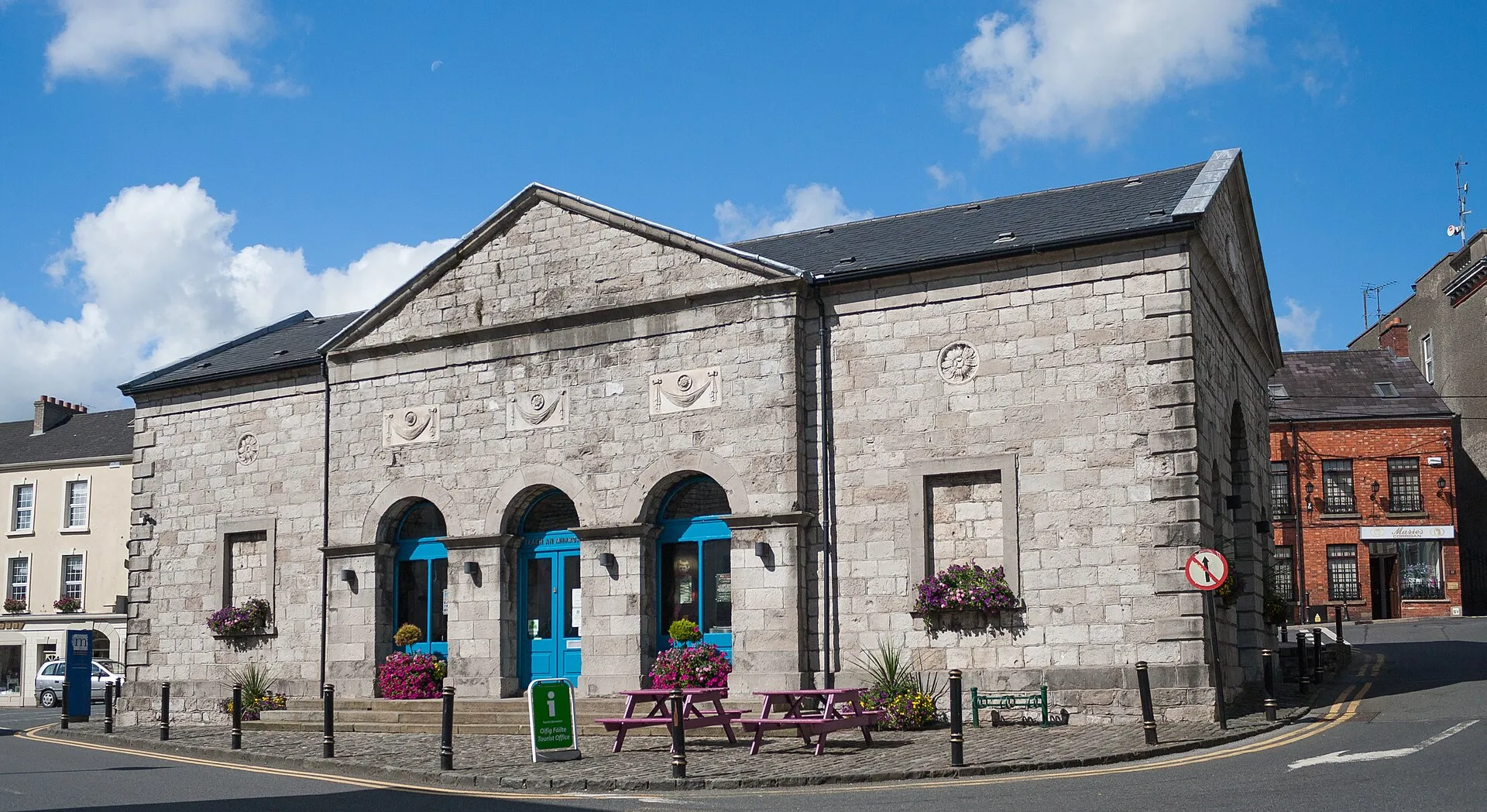
The Market House is the small classical building of grey limestone at the heart of Monaghan. It was built in 1792 for the practical business of buying and selling, but the quality of its carving is far beyond what a market shelter strictly required. That combination is what makes it worth stopping for. It is a civic building that wanted to be noticed.
Today it is used as an arts venue and gallery by Monaghan County Council. The trade has gone, the arches have been glazed in and the town around it has changed, but the building still has a public use more than two centuries after it was finished.
A market with ambition
The Market House was designed by Colonel Samuel Hayes of Avondale, County Wicklow, an amateur architect with a serious interest in landscape and classical design. The building was dedicated to Lieutenant General Robert Cuninghame, whose name survives in the carved inscription on the east pediment.
It is only five bays long. The middle three bays project slightly on each side and are topped by pediments, with another pediment at each end. The round arches below gave access to the market floor. Above them are carved swags, rosettes, roundels and family heraldry. Different finishes on the local limestone keep the walls lively even when the light is flat.
The result is much more delicate than the heavy grey stone first suggests. The National Inventory of Architectural Heritage gives it a national rating and describes it as one of the finest market houses of its type in Ireland.
What happened here
A market house was economic infrastructure. Grain, meal, flax, hay, poultry, fish, clothes and toys were among the goods traded in and around this one. Pork was important enough to the local economy to appear in contemporary accounts of the market. The building was also a meeting point. Market day brought the town and its rural hinterland into the same small space for news and business as well as shopping.
It remained important to Monaghan’s commercial life until the middle of the twentieth century. By then trade had moved into permanent shops, yards and other forms of distribution, and the open market floor no longer had its old purpose.
Many Irish market houses became offices, stores or empty shells. Monaghan’s was conserved and given a cultural use. That is a better fit than it may first appear. The building is still a shared room in the middle of town, only now the reason to gather is an exhibition, rehearsal, concert or meeting rather than a load of grain.
The Market House now
The venue is run through the Monaghan County Council Arts Office. The council’s current arts strategy keeps it available for exhibitions, artist workspace, rehearsals and meetings for arts groups. It is not a museum with a permanent display about the building itself, and there may be nothing public happening when you arrive.
The exterior is the reliable part of a visit. You can walk all the way around it and see the carved panels, blind windows, pediments and the central arcades in a few minutes. If you want to go inside, check the Arts Office page for the current programme and access before making a special journey. Discover Ireland’s listing is also useful for the visitor outline, but event details should always be checked at source.
Its place in the town
Monaghan’s centre is a sequence of four spaces rather than one main square. The Market House anchors Market Square. From here, Church Square, Old Cross Square and the Diamond are all a short walk, each with a different piece of the town’s history.
The contrast with the Rossmore Memorial in the Diamond is especially clear. The Market House is low, balanced and classical. The memorial is tall, crowded and Victorian. St Macartan’s Cathedral goes higher again. Together they show a town repeatedly using stone architecture to state what mattered to it at the time.
The things to do in Monaghan page connects all four squares into a short walk. For how trade, plantation and local government shaped the streets around them, continue with the history page. The later Gothic Revival landmark has its own guide at St Macartan’s Cathedral.
Details on this page last checked . If something here is out of date, it probably is our fault rather than yours.