A short history of Monaghan
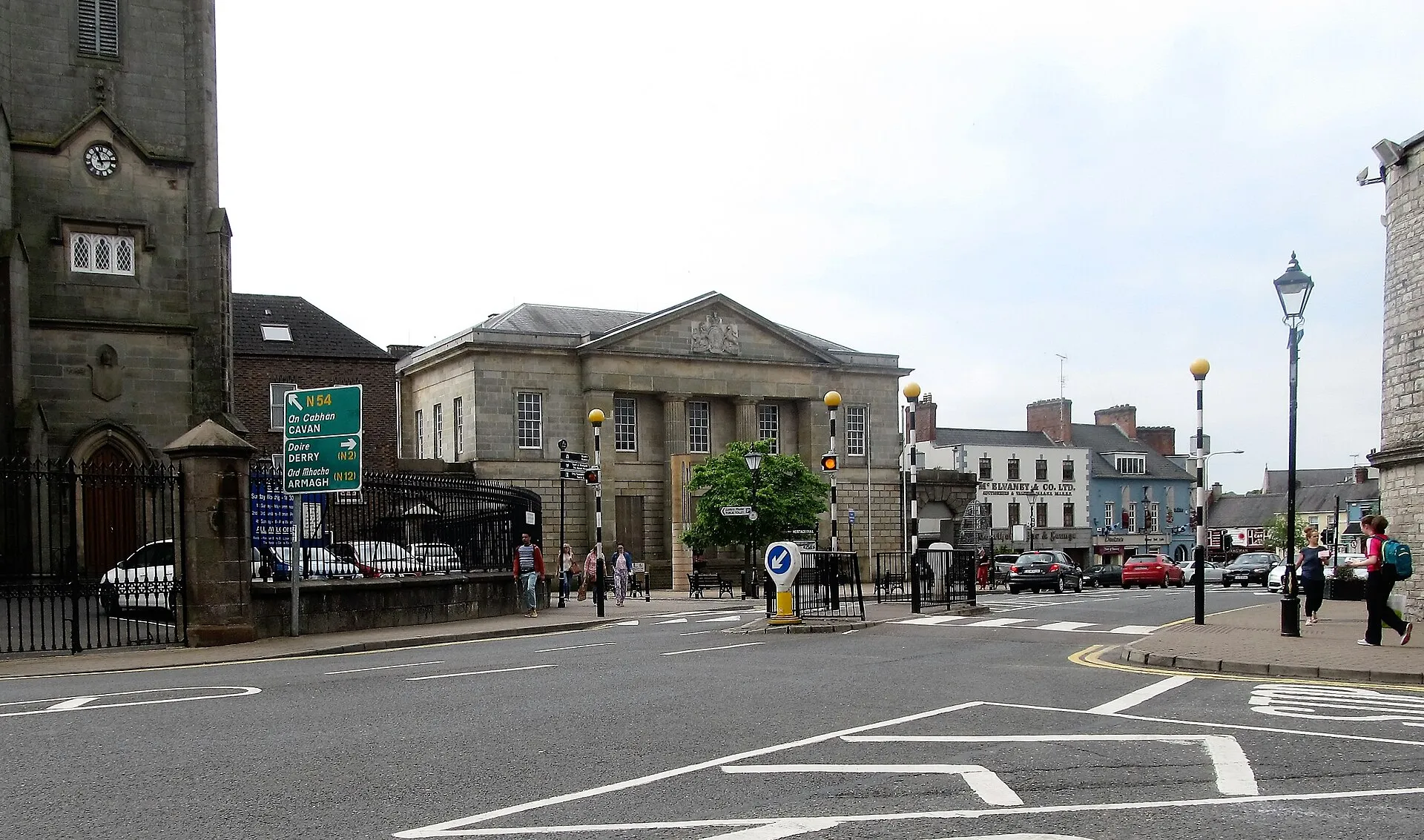
Monaghan is a plantation town built on an older Gaelic site, and almost everything odd about its layout comes from that. The name is Muineachán, from muine, meaning a thicket or a hillock. The county council’s preferred reading is land of the little hills, which anyone who has driven the roads around here will accept without argument. This is drumlin country, and the drumlins decided where the roads, the farms and the town itself could go.
Before the town
The area was MacMahon territory, part of the lordship of Airgíalla, and there was a Franciscan friary here from the fourteenth century. The crossing point and the small settlement around it mattered because the drumlins and the bogs made most other routes through this landscape impassable.
Monaghan received its charter in 1613 under the Ulster plantation, and the town that grew after that was laid out by settlers on a site that had already been fought over for a long time.
The four squares
The plantation layout is why the centre is a chain of four linked squares rather than a single main street.
Market Square holds the Market House of 1792, designed by Colonel William Hayes, a five bay limestone building that is still the best piece of architecture in the town.
Church Square got the courthouse in 1830, designed by Joseph Welland, along with St Patrick’s Church of Ireland. This is the formal, civic square, and it looks it.
The Diamond was the market cross square until 1876, when the Rossmore Memorial was put up: a Victorian drinking fountain of grey marble columns under a pinnacled spire, commemorating a member of the Westenra family. It is far too grand for the space, which is why people remember it.
Old Cross Square takes its name from the seventeenth century Old Cross, possibly originally a sundial, which stood in the Diamond until the Rossmore Memorial pushed it out in 1876.
Linen and the nineteenth century
Monaghan grew on linen. The county was part of the Ulster linen belt, and the town had markets, bleach greens and mills through the eighteenth and nineteenth centuries. That trade paid for the squares and most of the buildings you see in the centre.
The Westenra family, Barons Rossmore, became the principal landlords in 1801 and stayed so into the twentieth century. Their seat, Rossmore Castle, sat south west of the town in what is now the forest park. It was a large neo-Jacobean house, was abandoned after the Second World War when dry rot made it impossible to keep, and was demolished in the 1970s. The terraces and some stonework are still there in the trees, which is a strange thing to come across on a walk.
St Macartan’s Cathedral went up on the high ground on the Clones side between the 1860s and the end of the century, in the neo-gothic style, built with limestone from a quarry near Old Cross Square.
The border
Partition in 1921 did more to Monaghan than any other single event. The county had been part of Ulster and its trade, its rail links and its markets ran north. The border cut across all of that. Monaghan found itself at the end of a road rather than in the middle of one, and it stayed that way for most of the century. The railway closed in the 1950s and never came back.
On 17 May 1974 a car bomb exploded on Church Square, part of the co-ordinated Dublin and Monaghan bombings carried out by the Ulster Volunteer Force. Seven people were killed in Monaghan that evening: Patrick Askin, Thomas Campbell, Thomas Croarkin, Archie Harper, Jack Travers, Peggy White and George Williamson. Thirty three people died across the two towns that day, the highest death toll of any single day of the Troubles.
The memorial in front of the courthouse, seven shafts of light above bronze plates carrying the names, was unveiled by President Mary McAleese on 17 May 2004.
Since then
The town has grown steadily since the 1990s, and the 2022 census recorded 7,894 people living in it, making it the largest town in the county. The border is now an open road, and the trade that partition cut has largely returned.
The most visible recent change is the Peace Campus on the north side of town, which opened in 2025 and brought the county museum and the town library together under one roof. That a building funded on the theme of peace is now the main civic building of a town that carries the history above it is not an accident, and the museum’s permanent exhibition deals with it directly.
More on visiting the museum and the squares is on the things to do page.
Details on this page last checked . If something here is out of date, it probably is our fault rather than yours.